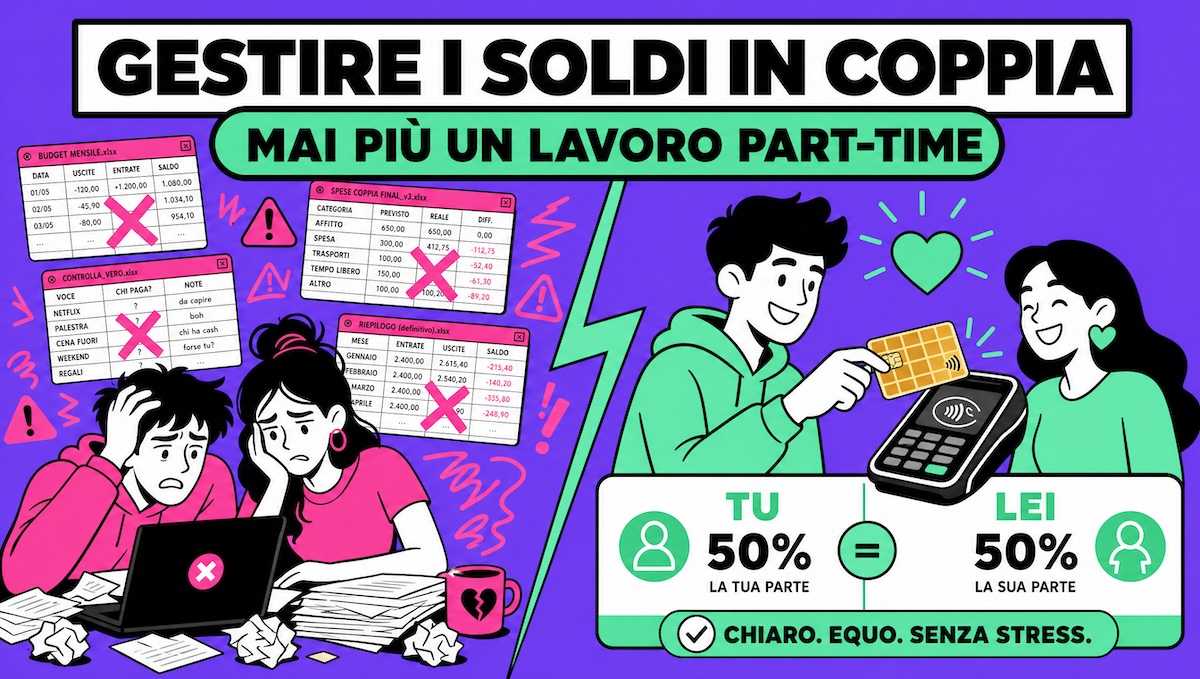
Managing money as a couple shouldn't feel like a part-time job.
And yet, between:
a lot of couples end up:
The truth?
Money isn't actually the problem.
The system is.
In 2026, more and more couples are looking for simple, modern ways to share expenses without turning the relationship into a spreadsheet.
A lot of couples start out this way:
At first it feels simple.
But after a while, problems start creeping in:
It only really works when:
Some couples open a shared account for:
This can work well for couples who've settled into life together.
If you've been considering something like a Revolut joint account, we've written a full guide on when it's actually worth it and when it isn't.
But not everyone feels comfortable with it. And a joint account doesn't always solve the real problem.
Because in real life:
And plenty of couples simply aren't ready for a fully shared account yet.
Especially early in a relationship, a lot of people want to:
Many people use tracking apps to log:
They're especially useful:
The catch?
You still have to:
So the mental load never really goes away.
Cino works differently.
Cino is a shared card that links both partners' bank cards and automatically splits payments in real time.
For example:
When you pay, Cino automatically charges each person's share from their own linked card, based on the split you've chosen.
So there's no need to:
The old default used to be:
Today, more couples prefer to:
Not because the relationship is "less serious."
But because:
Most arguments don't start over big amounts.
They start over small things like:
The problem was never really the €5.
It's the constant, low-level friction.
Between:
more people are splitting expenses every single day.
And nobody wants to spend the weekend doing accounting with their partner.
Which is exactly why new solutions built for paying together, automatically and naturally, are on the rise.
This fresh approach to shared payments earned Cino a spot in Mastercard Lighthouse, one of the most recognised fintech programmes in Europe.
Because more and more people don't just want to track expenses after they've paid.
They want to pay together directly, with no debts, no transfers, and no awkward moments.
Splitting expenses as a couple should be simple.
It shouldn't create:
Whether you choose:
what matters is finding a system that actually works in everyday life.
For a lot of modern couples, that system is Cino.
Want to stop chasing your partner for a transfer? Download Cino
.png)


